

When the Taps Almost Ran Dry
A reflection for World Water Day – 22 March

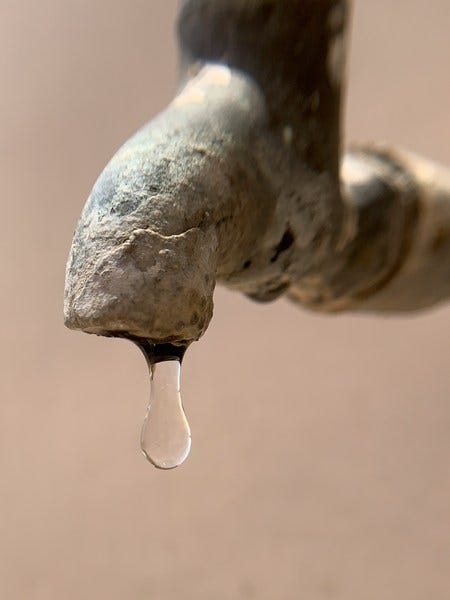
A personal reflection on Cape Town’s drought, when the city almost ran out of water. It’s a lesson the world shouldn’t ignore.
There was a time in Cape Town when every drop of water mattered.
Showers were timed. Buckets lived permanently in the bathroom. And the words “Day Zero” followed us everywhere — and was constantly in the back of our minds.
A reminder popped up on my phone recently: World Water Day – 22 March.
It instantly transported me back to those anxious months in 2017 and 2018, when Cape Town came frighteningly close to becoming the first major modern city to run out of water.
The crisis didn’t arrive overnight.
It began quietly in 2015, when rainfall dropped below normal and dam levels failed to recover during the winter rainy season. At first, many of us weren’t overly concerned. Droughts come and go, we told ourselves. The winter rains would arrive. The dams would fill again.
But the rains never really came.
By 2017, Cape Town had endured three consecutive years of drought. As the summer of 2017/2018 approached, the situation became critical. Severe water restrictions were implemented, and the once‑unthinkable idea of queuing for water began to feel possible.
With dam levels dropping toward 20%, “Day Zero” suddenly became part of everyday conversation.
What was “Day Zero”?
Day Zero was the point at which Cape Town’s municipal water supply would effectively run out. Taps across the city would be turned off.
Water wouldn’t disappear — but it would no longer come to us.
We would have to queue at designated distribution points, collecting our daily ration. .
The thought of thousands of people lining up for water felt surreal. Yet it came uncomfortably close to reality.
Fortunately, nature eventually showed mercy. Much‑needed winter rains arrived, filling the dams and washing away the immediate threat of Day Zero. By mid‑2018, life slowly began returning to normal.
But the experience lingered.
Life under water restrictions
Strict water restrictions were imposed across the city, with heavy fines for those who broke them.
Gardens could no longer be watered — heartbreaking for many of us as lawns, shrubs, and trees slowly wilted. Cars couldn’t be washed either (which, I must admit, wasn’t entirely bad news for me — I’ve never enjoyed washing cars).
Each resident was limited to 50 litres of water per day.
It doesn’t go very far.
I know — because I tried it.
Every action suddenly required thought. Before turning on a tap, you’d pause and ask yourself: Do I really need this water?
Buckets were placed under showers to collect water for flushing toilets. Showers were limited to two minutes. My brother took this rule very seriously and would bang on the bathroom door if anyone lingered too long.
And then there was the phrase that became famous across the city:
“If it’s yellow, let it mellow.”
Toilets were no longer flushed after every use. We even put bricks in the cistern to reduce how much water was used with each flush.
Despite the hardship, something remarkable happened. People adapted quickly. Awareness grew almost overnight, and water use dropped dramatically — from about 1.2 billion litres per day to roughly 500 million.
It was an extraordinary collective effort.
Why it matters globally
Long after the dams refilled, something in me didn’t quite reset.
Cape Town may have been one of the first major modern cities to come so close to running out of water — but it certainly won’t be the last. The crisis revealed how vulnerable urban water systems can be, and how much individual behaviour can influence the outcome.
It also changed the way many people think about water. After the drought, households across the city installed rainwater tanks, grey‑water systems, and even boreholes in an effort to protect themselves from future shortages.
Water awareness had taken root.
A reality for many
Cape Town is not alone in facing the threat of Day Zero.
Many cities around the world are confronting serious water scarcity, driven by growing populations, expanding agriculture, and climate change. For millions of people, Day Zero isn’t a looming threat — it’s their daily reality.
Entire communities depend on water trucks for their supply. Even here in Cape Town, thousands of families do not have running water in their homes. They rely on communal taps, carrying heavy containers back to their houses — often with small children helping.
When water is that precious, not a single drop is wasted.
A simple reminder
World Water Day is a reminder of something we’re very good at taking for granted.
Water feels endless — right up until it isn’t.
No matter who we are, or where we live, one truth remains the same:
we need to save water while we have it.
If this sounds familiar, or sparked a memory of your own, feel free to share — I always find it interesting how different (and similar) these experiences can be.
I've only experienced the relatively minor inconvenience of several days without water because of a water main break. Never on a community-wide basis, or for an extended period of time. Thanks for this call to pay closer attention to the many things that I take for granted. I hope that if our local community ever faces such a natural calamity, our better spirits will prevail over our lesser spirits.